NEUROPTIMAL® NEUROFEEDBACK · DEMENTIA & MEMORY
When memory changes, everyday life can feel unsettling — for the person living with dementia and for the family around them. NeurOptimal® Neurofeedback is a calm, non-invasive brain-training session that can sit gently alongside medical and aged care.
Led by Bita Farahani, senior occupational therapist · Sessions 33–45 minutes
FOR FAMILIES AND CARERS TOO
Dementia is not one disease. It is a group of conditions that affect memory, thinking, behaviour and the ability to manage everyday tasks, and it is not a normal part of ageing. Alzheimer’s disease is the most common form (Dementia Australia). Dementia is a major and growing health issue in Australia (AIHW).
Families often tell us that the hardest parts are not only memory loss. They are the restless evenings, broken sleep, worry, frustration and the moments when the person they love does not feel like themselves. Carers carry a great deal too.
Our focus is wellbeing: calm, rest, comfort and connection — supporting the person and their family, as part of the team around them.

Comfort and connection matter, for the person and the family.
UNDERSTANDING DEMENTIA
Dementia Australia explains that dementia is not one single disease. It is a collection of symptoms caused by changes or damage in the brain, and it is not a normal part of ageing (Dementia Australia).
In 2026 an estimated 446,500 Australians are living with dementia, and around 1.7 million people help care for someone who is (Dementia Australia, facts and figures).
More than 100 conditions can cause dementia. The most common are Alzheimer’s disease, vascular dementia (from reduced blood flow to the brain), Lewy body dementias and frontotemporal dementia. Dementia can also begin before 65 — this is called younger onset dementia (Dementia Australia, causes and types).
Brain cells and the connections between them are gradually affected. Each type tends to begin in different areas — memory, language, planning or behaviour — which is why dementia looks different from person to person (healthdirect).
Sleep and stress matter a great deal. Disturbed sleep is common and can make days harder for everyone at home, which is why rest, routine, movement and connection are such important parts of good dementia care.
Dementia Australia lists changes in memory, thinking, communication, planning and problem solving, and sometimes mood or behaviour. Some people find it harder to remember new information, follow conversations or keep track of things that once felt easy (Dementia Australia).

Shared memories and familiar routines can bring comfort.
For advice and support, call the National Dementia Helpline 1800 100 500.
WHAT THE RESEARCH SAYS
Researchers have begun to explore neurofeedback as a possible complementary approach in dementia and mild cognitive impairment. A 2021 systematic review found 10 studies; in most, participants improved on some cognitive tests, but randomised controlled trials were scarce and the evidence was judged inconclusive (Trambaiolli et al., 2021).
A second review of 14 studies in older adults, healthy or with a clinical condition, found improvements in memory, mainly with specific training protocols, but no effect on attention. The authors called for placebo-controlled, double-blind trials (Laborda-Sánchez & Cansino, 2021).
HOW NEUROPTIMAL® NEUROFEEDBACK MAY HELP
NeurOptimal® Neurofeedback is gentle and non-invasive. Small sensors simply listen to your brain’s electrical activity while you rest and listen to music. When the system notices a sudden shift, the music pauses for a split second. Your brain notices that tiny pause and reorganises in its own way. Nothing is sent into the body, and there is nothing to learn or get wrong.
Neurofeedback cannot slow, stop or reverse dementia, and it is not a treatment for Alzheimer’s disease. What families sometimes describe is a calmer, more settled day:
The session itself is quiet and passive — just sitting and listening to music. Some families say their loved one seems more settled afterwards.
Many people find sessions restful, and the NeurOptimal® Neurofeedback team frames its training as support for sleep management.
A calm, pleasant routine can bring a little more ease to the week.
Carers matter too. With a home rental, the whole household can train — unlimited sessions, up to two per person per day.

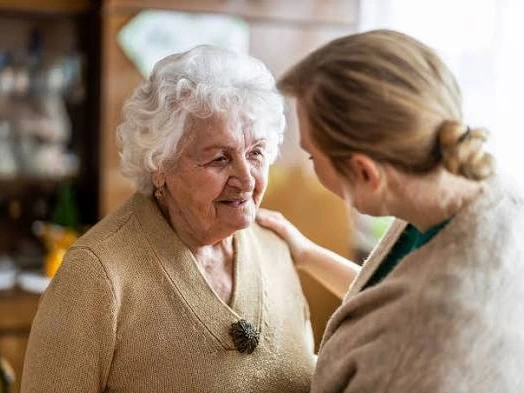
A calm, familiar routine, with someone you trust beside you.
NeurOptimal’s own wellness statements describe Alzheimer’s disease in terms of stress management and sleep management as part of a healthy lifestyle — never as a treatment for any condition (NeurOptimal®, wellness statements).
NeurOptimal’s library includes two small conference reports from France. They are not peer-reviewed trials:
Browse the full library on NeurOptimal’s research page. We are always happy to talk with families, GPs and aged-care teams — contact us, or professionals can use our referral page.
WHAT TO EXPECT
For people living with dementia we keep things simple and familiar: the same time of day, a favourite chair, and a family member or carer nearby if that helps.
We work with children, teens and adults from 4½ years of age. Questions? Contact us or call 0406 107 775. New to neurofeedback? Start with Neurofeedback, gently explained.
QUESTIONS
No. NeurOptimal® Neurofeedback does not diagnose, treat, slow or cure dementia or Alzheimer’s disease. We focus on calm, rest and wellbeing, alongside the person’s doctor and care team.
NeurOptimal® Neurofeedback is non-invasive: the sensors only listen, and nothing is sent into the brain. Please let us know about medical conditions and medications, and keep the person’s GP informed.
That is fine. Sessions can be paused or stopped at any time, and the person can rest, hold a hand or listen to familiar music. There is nothing to remember or do.
Often, yes. A home system can be delivered by Express Post anywhere in Australia, and a family member or carer can be shown how to run it. For residential aged care, please check with the facility first.
Yes. A home rental can be used by the whole household — unlimited sessions, up to two per person per day. Many carers find a session for themselves helps too.
Mental Health OT Australia
If you would like to talk it through, we are here. A short, no-pressure discovery call is a lovely first step — or call us, or send us a message. We will listen, answer your questions honestly, and help you decide what, if anything, comes next.
Led by Bita Farahani, senior occupational therapist · Wembley, Perth · Online and home rental Australia-wide
Prefer to write? Send us an enquiry and we will be in touch soon.
NeurOptimal® Neurofeedback is a general wellness brain-training system. It does not diagnose, treat, prevent or cure any medical or psychological condition, and individual experiences vary. It is not a substitute for advice or care from your GP or another qualified health professional. It is not a replacement for medical care and should complement — never replace — the care of your medical team. If you need urgent support, call Lifeline on 13 11 14 or 000 in an emergency. NeurOptimal® and Dynamical Neurofeedback® are registered trademarks of Zengar Institute Inc. Mental Health OT Australia does not promise NDIS or other funding for neurofeedback or device rental.