
Occupational therapy for bipolar disorder helps you build steady routines, protect your sleep and energy, and get back to the work, study, relationships and everyday activities that matter to you. Our team of senior occupational therapists works with adults and young people in person at our Wembley clinic in Perth, and by telehealth across Australia, always alongside your psychiatrist, GP and treating team. Our service is also well suited to people who are staying at home and looking to improve their daily living skills, such as routines, self-care, cooking and household tasks. We work with NDIS, Medicare and private health insurance funding, and we also write NDIS reports and Functional Capacity Assessments.
What is bipolar disorder?
Bipolar disorder is a mental health condition that causes big shifts in mood, energy, thinking and behaviour. Everyone has ups and downs, but in bipolar disorder these changes are more extreme, last for days or weeks, and make it hard to keep up with daily life. It used to be called manic depression.
It is more common than many people think. National figures show that around 2 in every 100 Australians aged 16 to 85, close to 390,000 people, had bipolar disorder in the past 12 months. Symptoms usually first appear in the late teens or early adulthood.
There are three main types:
- Bipolar I disorder. At least one episode of mania. Most people also have episodes of depression.
- Bipolar II disorder. At least one episode of hypomania (a milder high) and at least one episode of depression.
- Cyclothymic disorder. Ongoing, milder ups and downs that do not meet the full criteria for a mood episode.
Bipolar disorder is a long-term condition, but it can be managed. With the right treatment and support, many people live full and meaningful lives, with long periods of stable mood.
Symptoms of bipolar disorder
Symptoms come in episodes, often with periods of more stable mood in between. They look different for each person.
Mania and hypomania (the “highs”)
- feeling unusually high, excited or irritable
- needing much less sleep but not feeling tired
- racing thoughts and talking fast
- big plans, starting many projects at once, or feeling unusually important
- being easily distracted
- risky choices, such as overspending, unsafe driving, or sudden decisions about work or relationships
Mania lasts at least a week and can be severe enough to need hospital care. Some people also have psychosis, such as hearing voices or holding beliefs that are not based in reality. Hypomania is shorter and milder, but other people often notice the change.
Depression (the “lows”)
- low, empty or hopeless mood for most of the day
- loss of interest in things you usually enjoy
- low energy, slowed thinking and trouble getting started
- sleeping much more or much less than usual
- changes in appetite and weight
- feeling worthless or guilty
- thoughts of death or suicide
Mixed features and early warning signs
Some people have symptoms of highs and lows at the same time, such as feeling agitated and low together. Many people also notice early warning signs before an episode, like sleeping less, feeling more driven or more irritable, or pulling away from people. Learning your own early warning signs is one of the most useful steps in managing bipolar disorder.
What happens inside the brain in bipolar disorder?
There is no single cause of bipolar disorder. It comes from a mix of genes, brain biology and life events. It often runs in families, and large genetic studies have found many genes that each add a small amount of risk. Stress, sleep loss, substance use and big changes to daily routine can trigger episodes in people who are already at risk.
Researchers have found several brain systems that work differently in bipolar disorder. These findings come from groups of people in studies, so they do not describe every person and cannot be used to diagnose bipolar disorder.
The emotion and control circuits
The brain has a “feeling” system and a “thinking and braking” system. The amygdala and other deep (limbic) areas respond quickly to emotion. The prefrontal cortex, behind the forehead, helps us pause, plan and calm strong feelings. In bipolar disorder, brain scans show that the links between these areas, called the prefrontal-limbic (or fronto-limbic) network, often work differently. During mania, studies show more activity in the amygdala and less activity in parts of the prefrontal cortex. These differences can show up even when mood is stable.
The body clock and sleep
Bipolar disorder is closely linked with the body clock (circadian rhythm), which controls when we feel sleepy, alert and hungry. Many people with bipolar disorder have a body clock that is more easily thrown off. Sleep loss, shift work, jet lag and late nights can shift mood, and less sleep is often one of the first signs of a high. This is why a steady daily rhythm is so important.
Dopamine and the reward system
Dopamine is a chemical messenger that drives motivation, reward and the urge to act. Researchers think dopamine activity may run too high during mania and too low during depression. This may explain why highs can bring strong drive and risk-taking, and lows can bring flat motivation.
The stress system
The body’s main stress system (the HPA axis, which releases cortisol) tends to be more active in bipolar disorder. Ongoing stress may make the brain more sensitive to mood changes.
Brain structure
Large international brain imaging studies have found small differences, on average, in the thickness of the brain’s outer layer in frontal and temporal areas, and in the brain’s white matter connections. These are group differences and are not visible on a person’s own brain scan.
How bipolar disorder affects brain function and behaviour
These brain changes show up in everyday thinking and behaviour:
- Emotion regulation. Feelings can rise faster and take longer to settle, which can lead to irritability, tears or arguments that seem out of proportion.
- Energy and activity. During highs, people may take on too much, sleep very little and rush between tasks. During lows, even small tasks can feel impossible.
- Thinking skills. Many people notice problems with attention, memory, planning and mental speed. For some people these continue between episodes and can affect work and study.
- Impulsivity and reward. A strong pull toward rewards can lead to spending, risky choices or saying things you later regret.
- Insight. During a high, it can be hard to notice that anything is wrong. Family and friends may notice the change first.
How bipolar disorder can affect everyday life
Bipolar disorder affects much more than mood. It can touch almost every part of life:
- Work. Time off during episodes, trouble concentrating, or taking on too much during a high and then burning out.
- Study. Missed classes or deadlines, and trouble keeping up with assignments and exams.
- Relationships. Conflict, mistrust after a high, or withdrawing from people during a low. Partners and families can feel stressed and unsure how to help.
- Routines. Days can swing from overfull to empty, making self-care, meals, housework and appointments hard to keep up.
- Sleep. Very little sleep during highs and too much sleep during lows, which then feeds the next mood change.
- Finances. Overspending, debt or impulsive purchases during highs, and lost income during lows.
- Physical health. People with bipolar disorder have higher rates of heart disease, diabetes and weight gain, partly linked to sleep, activity, diet and some medicines. Looking after physical health matters too.
- Confidence and identity. Stigma, and feeling unsure who you are between episodes, can make it harder to take part in life.
Recovery: how to get back to life with bipolar disorder
Recovery does not always mean having no symptoms. For many people, it means feeling in charge of their life again: understanding the condition, staying well for longer, and getting back to work, study, relationships and the things they enjoy. Research shows that skills-based psychosocial supports, used together with medication, can help people stay well and function better.
Steps that can help:
- Work closely with your treating team. Your psychiatrist and GP guide diagnosis and medication. Medication is a core part of treatment for most people. Talk to your doctor before making any change.
- Keep a steady daily rhythm. Get up, eat, move and go to bed at similar times each day, even on weekends. A therapy called interpersonal and social rhythm therapy (IPSRT) is built on this idea, and trials link it with longer periods of wellness.
- Protect your sleep. A regular sleep window, a wind-down routine and planning ahead for travel and shift changes. A trial of an insomnia program adapted for bipolar disorder found better sleep, better functioning and fewer mood relapses.
- Learn your patterns. Track mood, sleep and energy, and write down your early warning signs.
- Make a wellness and relapse prevention plan. Agree on what you, your family and your treating team will do if warning signs appear.
- Pace your energy. Plan your week, avoid overcommitting when you feel high, and set small, doable goals when you feel low.
- Move, eat well and limit alcohol and drugs. Lifestyle programs that combine activity and healthy eating have been linked with lower depression and better functioning.
- Stay connected. Supportive people, peer groups and meaningful roles help protect wellbeing.
- Take graded steps back. Return to work, study and social life step by step, at a pace you can keep up.
How occupational therapy for bipolar disorder can help
Occupational therapists focus on everyday life: what you need and want to do, and what is getting in the way. Our team of senior occupational therapists works with you, your family if you wish, and your psychiatrist, GP or psychologist. We do not change medication or replace medical care. We help you put the strategies that keep you well into your real life.
If you are spending most of your time at home and want to build your daily living skills, our service is a good fit. We can work with you by telehealth in your own home, or at our Wembley clinic, on morning and evening routines, self-care, planning and cooking meals, keeping on top of household tasks, managing appointments and medication routines, and building confidence to get out into the community, one step at a time.
Your OT program may include:
- Functional assessment. A clear picture of your strengths, daily routines, roles and the areas you want to work on.
- Daily rhythm and routine. Building a regular, realistic routine for waking, meals, activity, social contact and bedtime, using IPSRT-style social rhythm tracking.
- Sleep support. Practical changes to sleep timing, wind-down, light, screens and caffeine, and plans for travel, night shifts and big events.
- Energy and activity balance. Pacing during highs and graded, achievable activity during lows.
- Early warning signs and wellness plans. A written plan, shared with people you trust, that sets out the signs to watch and the steps to take.
- Work and study. Return-to-work and study planning, workplace adjustments, time management and strategies for focus and memory.
- Money safeguards. Budgeting systems and agreed limits, such as cooling-off rules for big purchases, to reduce financial harm during highs.
- Life skills. Confidence with cooking, shopping, housework, managing appointments and medication routines.
- Relationships and community. Rebuilding social connection, hobbies and meaningful roles, and supporting families and carers to understand how to help.
- Sensory and regulation strategies. Calming and grounding strategies for stressful moments.
Research on occupational therapy for bipolar disorder specifically is still limited. Our work draws on evidence for related approaches, such as social rhythm, sleep and lifestyle programs, functional remediation and supported employment. Progress is different for everyone, and we review your goals with you regularly. If you also live with psychosis, you may find our article on schizoaffective disorder and occupational therapy helpful. We also support people with anxiety and depression.
What brain imaging tells us about bipolar disorder
Brain imaging studies, such as PET and fMRI scans, suggest that brain activity can look different during depressive and manic episodes. In research, some areas tend to show lower activity during depression and higher activity during mania. This helps explain why energy, sleep, motivation and thinking can change so much from one phase to the next.
These scans are research tools. They aren’t used to diagnose bipolar disorder, and diagnosis is made by a doctor or psychiatrist. They do show that bipolar disorder affects how the brain works, and that it isn’t a matter of willpower or character.
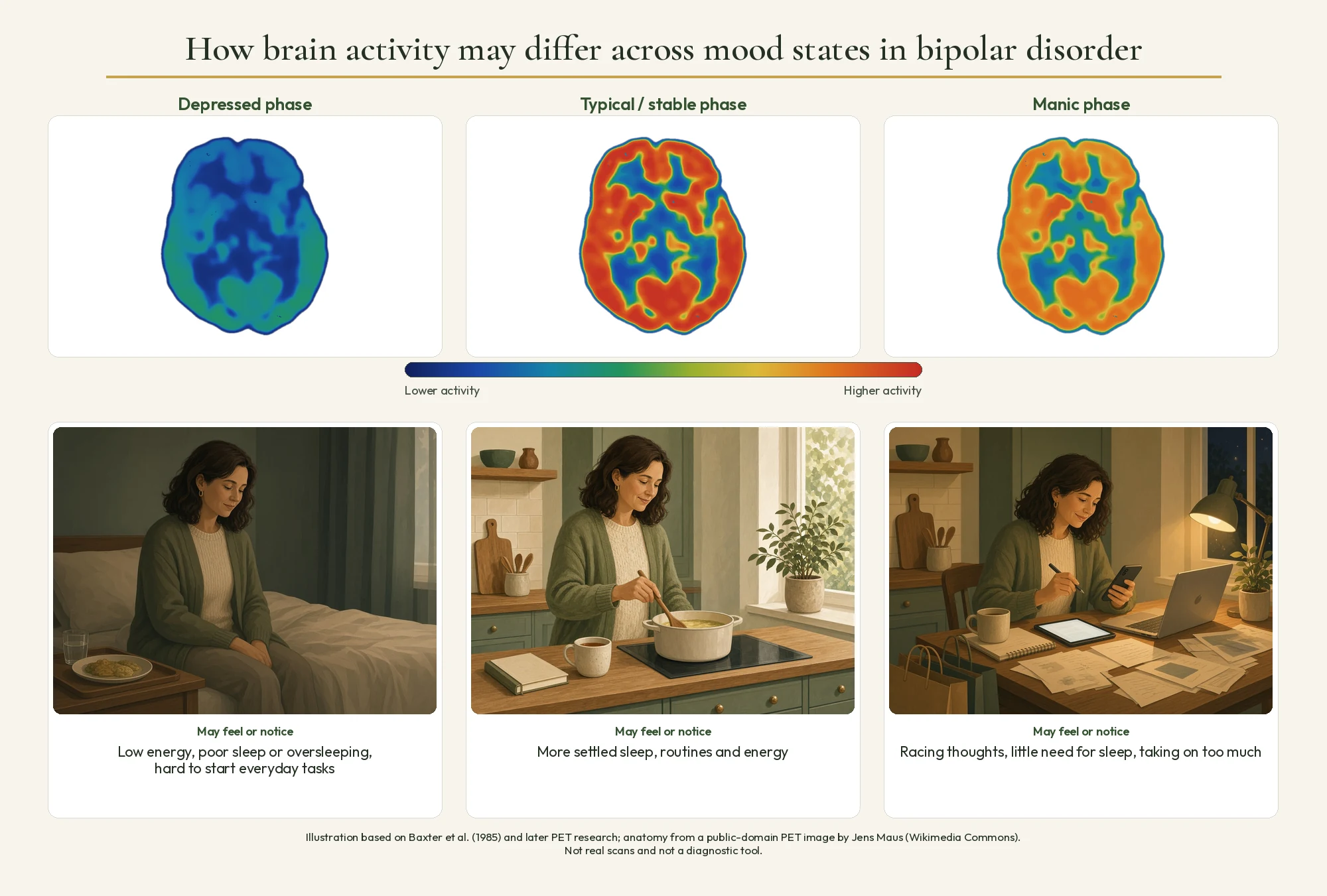
How to read the colours
The colours show how much fuel (glucose) each brain area is using, from blue (less) to red (more). In a typical brain, red along the outer edge is normal: that is the thinking layer, which always uses the most fuel. Blue in the centre is also normal, because it is fluid spaces and wiring that use little fuel.
The comparison that matters is between phases. In the depressed phase, much less of the brain shows warm colours, meaning activity is lower overall. In the manic phase, activity is raised in some areas compared with depression. Colours are not “good” or “bad”; they only show more or less activity.
Why this matters for daily life
When activity levels shift, everyday tasks can shift too. Getting up, cooking, keeping appointments, working or studying may feel very hard during a low. During a high, you might take on too much or lose track of sleep. Our occupational therapy team helps you build steady routines and sleep habits. We also help you set up early-warning plans and practical strategies, so daily life feels more manageable across every phase. This includes people staying at home who want to improve their daily living skills.
NDIS support for bipolar disorder
Bipolar disorder can lead to a psychosocial disability when it has a lasting impact on daily life. If you are an NDIS participant, or you are thinking about applying, our team can help with both therapy and reports.
NDIS psychosocial occupational therapy supports
For NDIS participants with a psychosocial disability, OT is usually funded under Capacity Building, Improved Daily Living. Your NDIS OT supports may focus on routines and sleep, daily living skills, managing money, getting back to work or study, community access, and building skills to stay well during episodes. Sessions can be in person in Perth or by telehealth across Australia. Read about OT in NDIS and NDIS occupational therapy for mental health.
NDIS reports and assessments
Bipolar disorder is episodic, so your needs can change a lot from month to month. Good evidence needs to show what your life is like on harder days, not just on a good day. Our senior occupational therapists write:
- Functional Capacity Assessments (FCAs). A detailed report on how bipolar disorder affects self-care, home life, social life, community access, work or study, and the support you need. Learn about our Functional Capacity Assessments.
- OT reports for NDIS access. Functional evidence to sit alongside reports from your psychiatrist or GP when you apply for the NDIS.
- Reports for plan reassessments. A current picture of your functioning, progress and goals, with clear reasons for the supports you need. This is sometimes still called a plan review.
- Changed circumstances. Updated evidence if your health, living situation or informal supports change.
- Standardised assessments. Tools such as WHODAS 2.0, which the NDIA lists as an example of disability evidence. See our NDIS assessments.
Our reports describe function and support needs. They do not diagnose bipolar disorder, and we cannot promise any NDIS decision. Support coordinators, plan managers, LACs, participants and families can make a referral.
Medicare and private health insurance
Medicare occupational therapy
If you have a chronic condition and complex care needs, your GP may prepare a chronic condition management plan and refer you for OT. You may then be able to claim a Medicare rebate for a limited number of sessions each year. Read about OT in Medicare.
Private health insurance
If your extras cover includes occupational therapy, you may be able to claim on the spot with HICAPS and pay any gap. Benefits and limits vary between funds. Read about OT and private health.
You can also see us privately without a referral, and we see DVA clients. What you can claim depends on your eligibility, your plan and your fund. Our fees page has current prices.
Neurofeedback across Australia
Some clients choose to add NeurOptimal® neurofeedback brain training to their OT program. Sensors on the scalp read your brain’s activity while you relax, listen to music or watch a film. The system gives your brain brief feedback, in the form of short pauses in the sound. It is non-invasive and nothing is sent into the brain.
People often use neurofeedback to support relaxation, sleep, focus and self-regulation as part of their general wellbeing. NeurOptimal® is a wellness brain-training system. It does not diagnose, treat or cure any condition, and it is never a replacement for medication or care from your psychiatrist or GP. It works alongside your OT program and your treating team.
Sessions can happen at our Wembley clinic, or with a neurofeedback rental system at home anywhere in Australia, with guidance from our team. Read more about neurofeedback in occupational therapy and our neurofeedback research page.
Telehealth OT for bipolar disorder across Australia
You do not need to live in Perth to work with us. We offer telehealth occupational therapy by secure video to people across Australia, including regional and remote areas.
How telehealth sessions work:
- You book online or by phone, and we send you a secure video link, usually through Cliniko.
- You join from a quiet, private space on a phone, tablet or computer with a camera and internet connection.
- Sessions follow the same steps as in clinic: talking through your goals, building routines and plans, and practising strategies.
- Your OT can see your real environment, such as your kitchen, desk or bedroom, so plans fit your daily life.
- A family member or support person can join if you want them to.
- Telehealth can make it easier to keep going when energy is low or travel is hard.
Find out more about our OT telehealth services. If you are in Perth, you are welcome at our clinic at Unit 10B, Level 1, Foyer B, 151 Herdsman Parade, Wembley WA 6014.
Frequently asked questions
Can an occupational therapist help with bipolar disorder?
Yes. Occupational therapists help people manage the impact of bipolar disorder on daily life. This includes steady routines, sleep, pacing energy, early warning sign plans, money safeguards and getting back to work or study. OT works alongside care from your psychiatrist, GP and psychologist, and does not replace medication.
How is OT different from seeing a psychiatrist or psychologist?
A psychiatrist diagnoses bipolar disorder and manages medication. A psychologist mainly works on thoughts, feelings and behaviour. An occupational therapist focuses on everyday doing: routines, self-care, work, study, relationships and community life. Many people find that these supports work well together.
Can I get NDIS funding for bipolar disorder?
Some people with bipolar disorder are eligible for the NDIS if the condition causes a psychosocial disability that is likely to be lifelong and substantially affects daily life. Eligibility is decided by the NDIA. Our team can provide functional evidence, such as a Functional Capacity Assessment, but we cannot promise any NDIS decision.
What is a Functional Capacity Assessment for bipolar disorder?
A Functional Capacity Assessment is a report by an occupational therapist that describes how bipolar disorder affects everyday activities, such as self-care, home tasks, social life, community access and work or study. It also explains the support you need. Because bipolar disorder is episodic, the report looks at both good and harder periods.
Can neurofeedback be part of my support for bipolar disorder?
Some people choose to add NeurOptimal® neurofeedback to their OT program to support relaxation, sleep and self-regulation as part of their general wellbeing. NeurOptimal® is a wellness brain-training system. It does not diagnose, treat or cure any condition, and it works alongside OT and care from your psychiatrist or GP, never as a replacement.
Can I do occupational therapy for bipolar disorder by telehealth?
Yes. We offer telehealth OT by secure video across Australia, including regional and remote areas, and in-person sessions at our Wembley clinic in Perth. No referral is needed for private or NDIS sessions. A GP referral is needed to claim a Medicare rebate.
Take the first step
Living with bipolar disorder can feel unpredictable, but you do not have to work it out alone. Book a free 15-minute discovery call to talk about what is happening and how our team of senior occupational therapists may be able to help, in Perth or by telehealth anywhere in Australia.
Need help now? If you or someone you know is in immediate danger, call 000. For 24/7 crisis support, call Lifeline on 13 11 14 or the Suicide Call Back Service on 1300 659 467. In Perth, the Mental Health Emergency Response Line is 1300 555 788. If you notice signs of a mood episode, contact your psychiatrist, GP or mental health team early. Our service is not a crisis service. For more information about bipolar disorder, visit SANE Australia or the Black Dog Institute.