Photobiomodulation (PBM) uses gentle red and near-infrared light. Our senior occupational therapists may include a PBM helmet as one optional part of an occupational therapy plan, alongside the everyday strategies at the heart of OT. Research is still emerging, and PBM is never a replacement for your usual care.
Photobiomodulation is a non-invasive light therapy. It uses low-level red and near-infrared light, usually from LEDs or low-level lasers, at strengths that are not meant to heat or damage tissue. You may also hear it called low-level light therapy, low-level laser therapy (LLLT) or red light therapy.
It has been studied most for pain, wound healing and mouth sores after cancer treatment. Applying light to the head, called transcranial photobiomodulation, is a newer area of research. Its use for brain and mental health is still experimental.
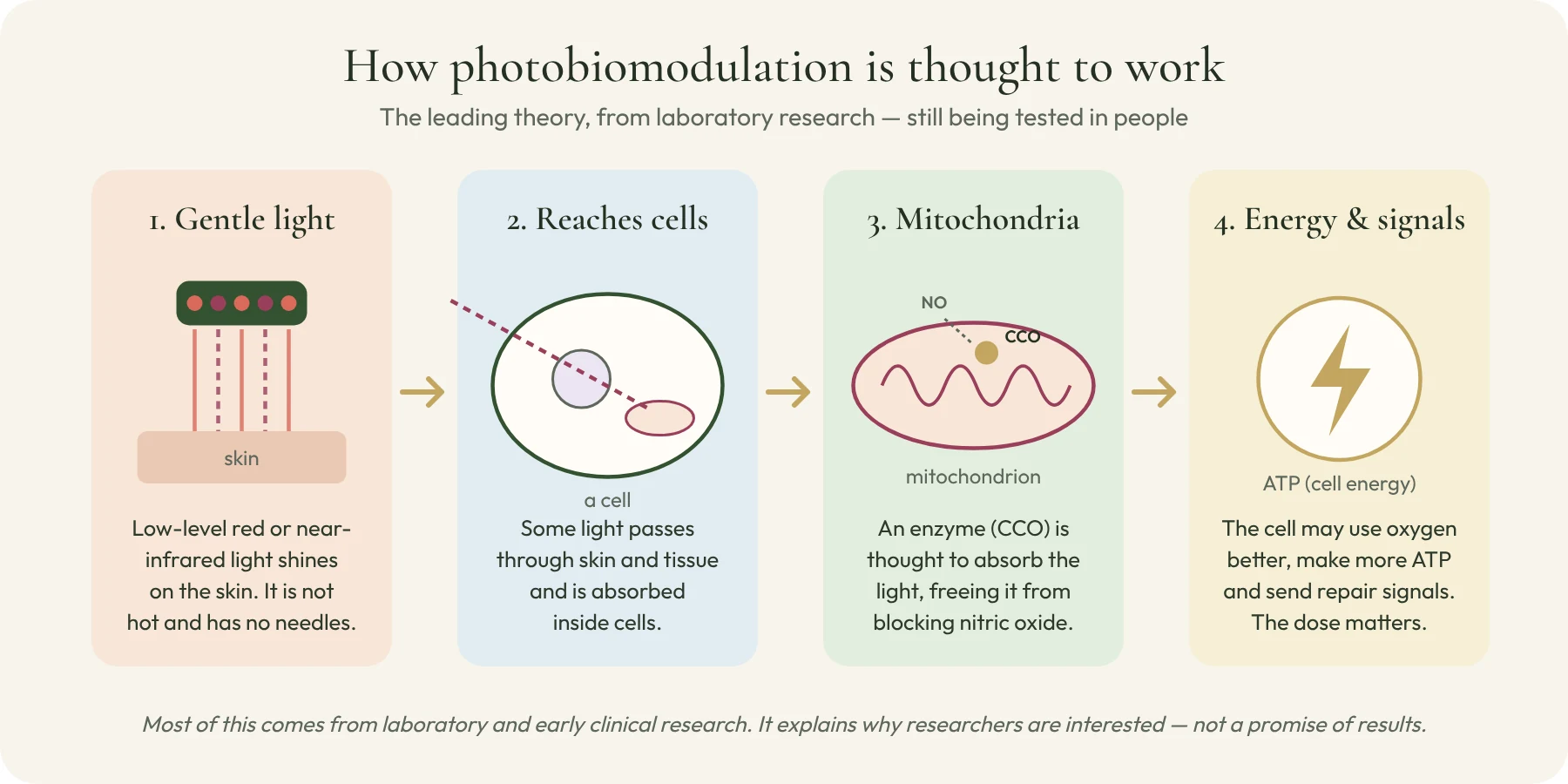
The leading theory comes from laboratory research. Inside our cells are mitochondria, often described as the cell's batteries. One of their enzymes, cytochrome c oxidase (also called complex IV), is thought to act as the main "light receptor" for red and near-infrared light.
When cells are stressed, a molecule called nitric oxide can attach to this enzyme and slow down how well the cell uses oxygen. Researchers think light may release the nitric oxide, so the enzyme can use oxygen again and the cell can make more of its energy molecule, ATP.
This is thought to set off a chain of signals inside the cell, involving nitric oxide, reactive oxygen species and a messenger called cyclic AMP. These signals may switch on genes linked to repair and protection (Hamblin, 2017; Dompe et al., 2020).
The dose matters. Researchers describe a "biphasic" pattern: a little light may stimulate cells, while too much may have no effect or even the opposite effect, so more is not better (Dompe et al., 2020). Much of this understanding comes from laboratory and animal research, so it explains why researchers are interested. It does not promise a result.
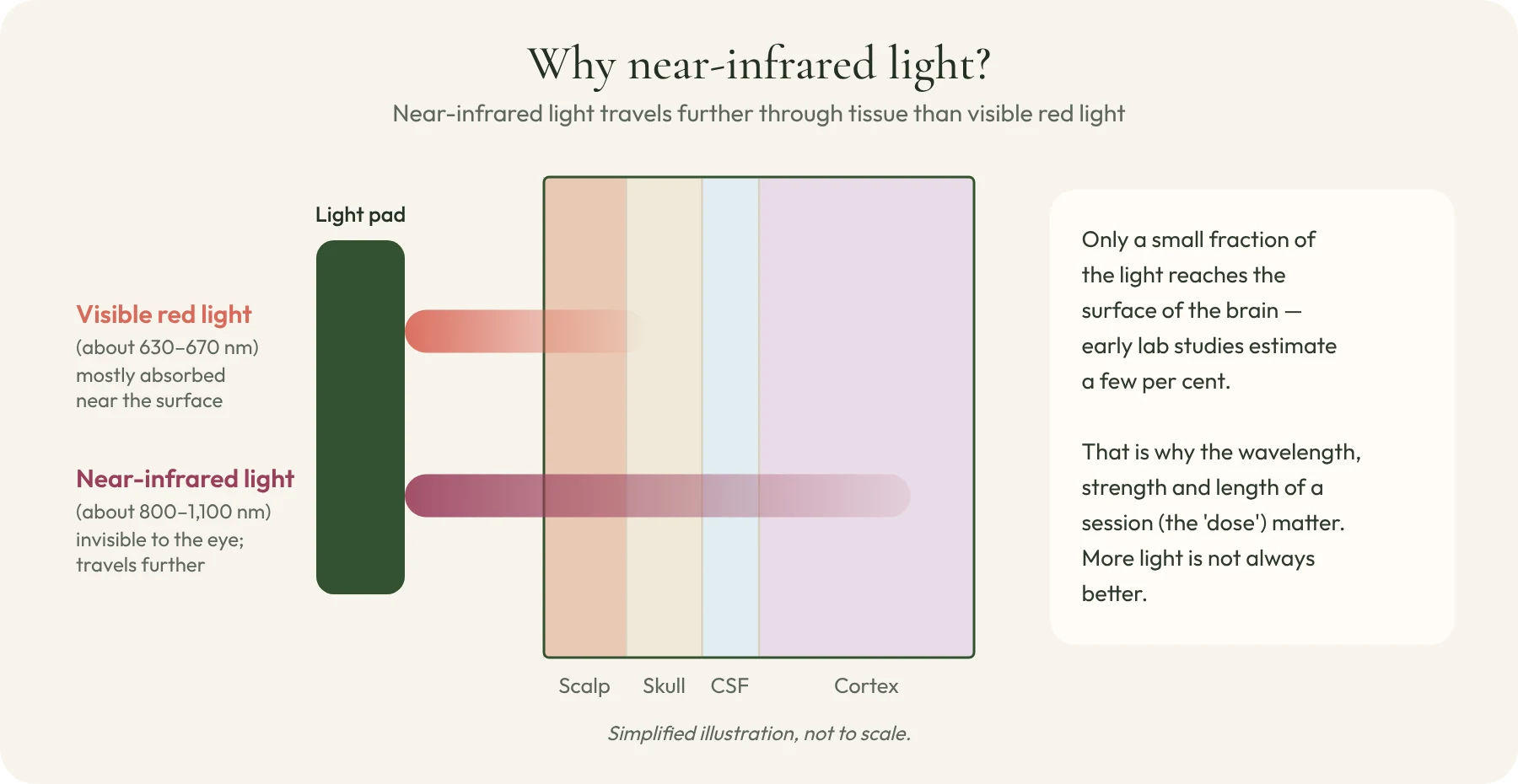
Visible red light is mostly absorbed near the surface of the skin. Near-infrared light, which you cannot see, travels further through tissue. Most brain-focused studies use near-infrared light between about 800 and 1,100 nm, with 810 nm the most studied.
Early research suggests near-infrared light can reach the outer layers of the brain (the cortex), including areas involved in focus, mood and memory. Only a small fraction of the light gets through the scalp and skull, though. Measurements in human cadaver heads suggest a few per cent at most, so the strength and timing of the light are chosen carefully, and devices are not all the same.
The helmet our team uses is an LED helmet. It delivers two near-infrared wavelengths, 810 nm and 1070 nm. Its settings can be adjusted, and your occupational therapist sets them for you and reviews them over time.
Researchers think different wavelengths may act on cells in slightly different ways. Most of this comes from laboratory and animal studies, summarised in reviews of mostly cell research (Dompe et al., 2020).
The most studied wavelength in brain research. Red light and near-infrared light up to around 810 nm are thought to be absorbed mainly by the energy-producing enzyme in mitochondria (cytochrome c oxidase).
A newer area of research. Longer near-infrared wavelengths are thought to act partly through light- and heat-sensitive channels in cell membranes (TRP channels). These may let calcium into the cell, which then interacts with other signals such as reactive oxygen species and cyclic AMP. A mouse study also suggests effects on the brain's immune cells (microglia). Human research is still limited. A small placebo-controlled pilot study at 1068 nm, a wavelength close to 1070 nm, looked at memory in healthy adults over 45 (Dougal et al., 2021).
Whether combining wavelengths makes a difference for people has not yet been tested in good-quality human trials.
Occupational therapy is about the things that fill your day: getting ready, learning, working, resting, playing and connecting with others. Photobiomodulation is never the whole plan. When it suits you, it sits alongside OT strategies such as breathing and calming routines, sensory approaches, pacing and practising everyday tasks.
Our senior occupational therapists may talk with you about PBM when it could fit your goals in areas like these:
Finding a calmer state, and recovering after overwhelm or shutdown.
Cognitive fatigue and brain fog that make starting and finishing tasks hard.
Busy places that lead to avoidance, agitation or exhaustion.
Sleep and recovery that affect how you manage the day.
Simple routines that fit family life and share the load.
PBM is never offered on its own or as a treatment for any condition, and it isn't right for everyone. We talk it through with you, and with your GP or other providers where you agree.
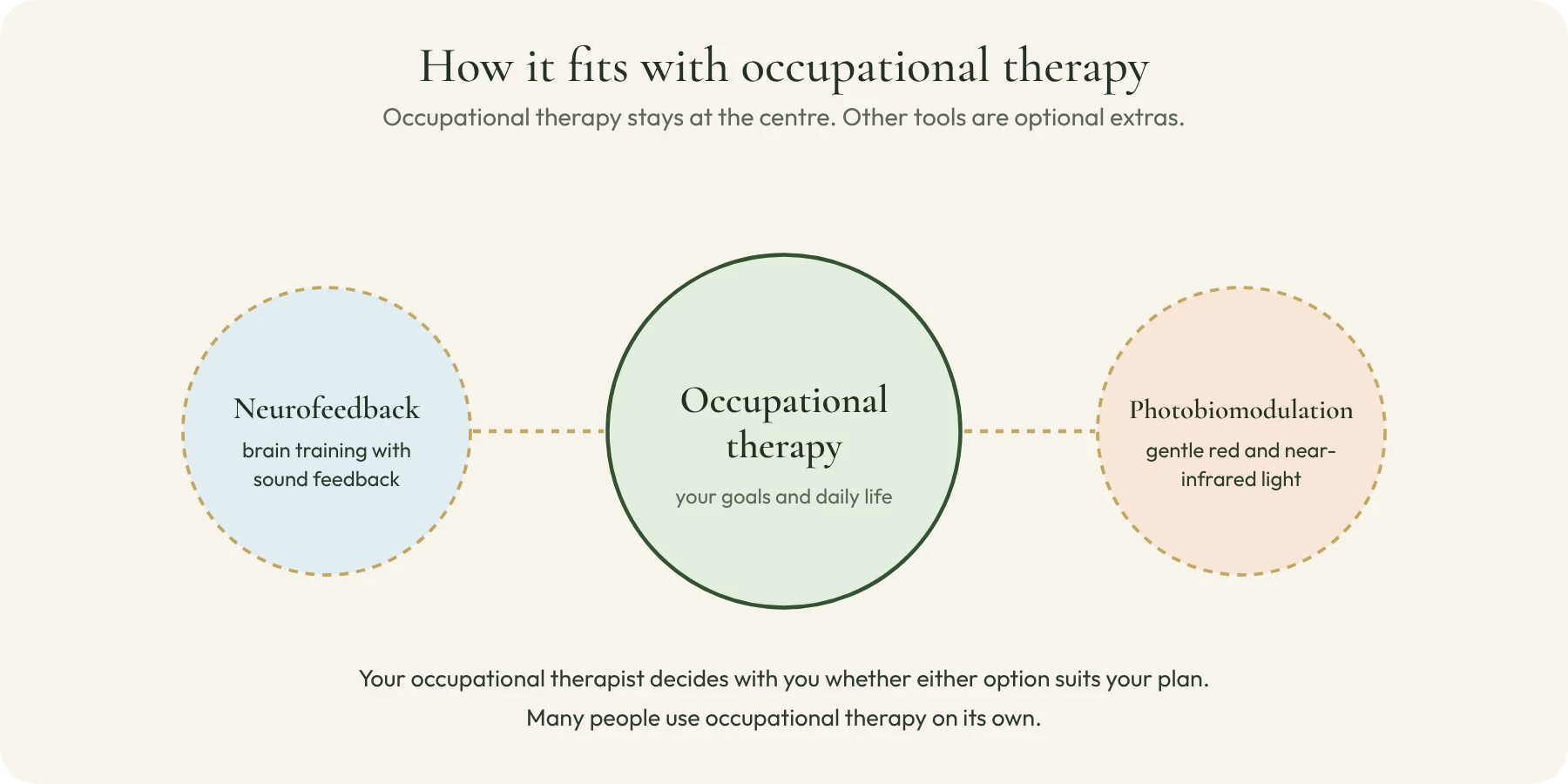
Some people also use neurofeedback, a gentle brain-training approach that reads the brain's activity and sends nothing into it. Photobiomodulation is different: it delivers light. Your occupational therapist can help you decide whether either, both or neither fits your plan. If stress is your main concern, see occupational therapy for stress management and neurofeedback for stress and anxiety.
Photobiomodulation can be part of your OT program in the way that suits your routine. Your occupational therapist helps you choose, and the plan can change over time.
Sessions at our Wembley clinic, as part of your occupational therapy appointments.
Hire a helmet to use at home, with setup, training and regular reviews from your OT.
Buy a helmet for ongoing home use, privately or, where the NDIA approves it, as NDIS assistive technology.
Setup, training and reviews can happen by telehealth, so you can be supported from anywhere in Australia.
Hire and purchase prices are available on enquiry. Contact us or book a 15-Minute Free Discovery Call to talk through the options.
For some NDIS participants, a home photobiomodulation helmet may be considered as low-cost assistive technology (AT). Our role is to assess whether it fits your goals, explain the options honestly and, if suitable, prepare the clinical information the NDIA asks for.
Funding is decided by the NDIA and depends on your plan and goals. We can't promise a funding decision. If PBM isn't funded or isn't right for you, your occupational therapy continues without it.
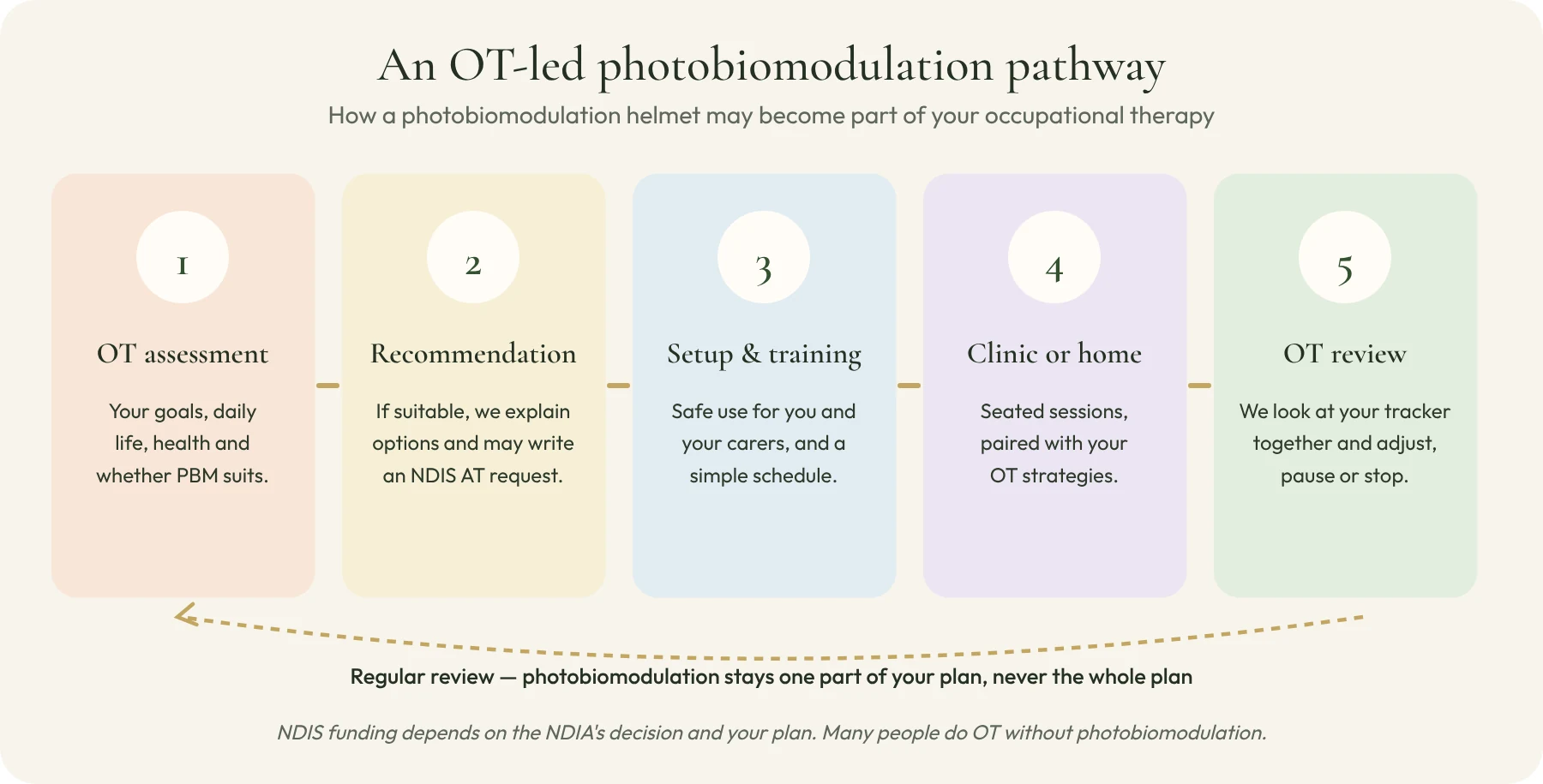
We look at your goals, daily routines, health and other supports, and whether PBM is a sensible option to explore.
If suitable, we explain what research does and doesn't show, and may write an NDIS assistive technology request.
We show you and your carers how to use the helmet safely and agree a simple schedule.
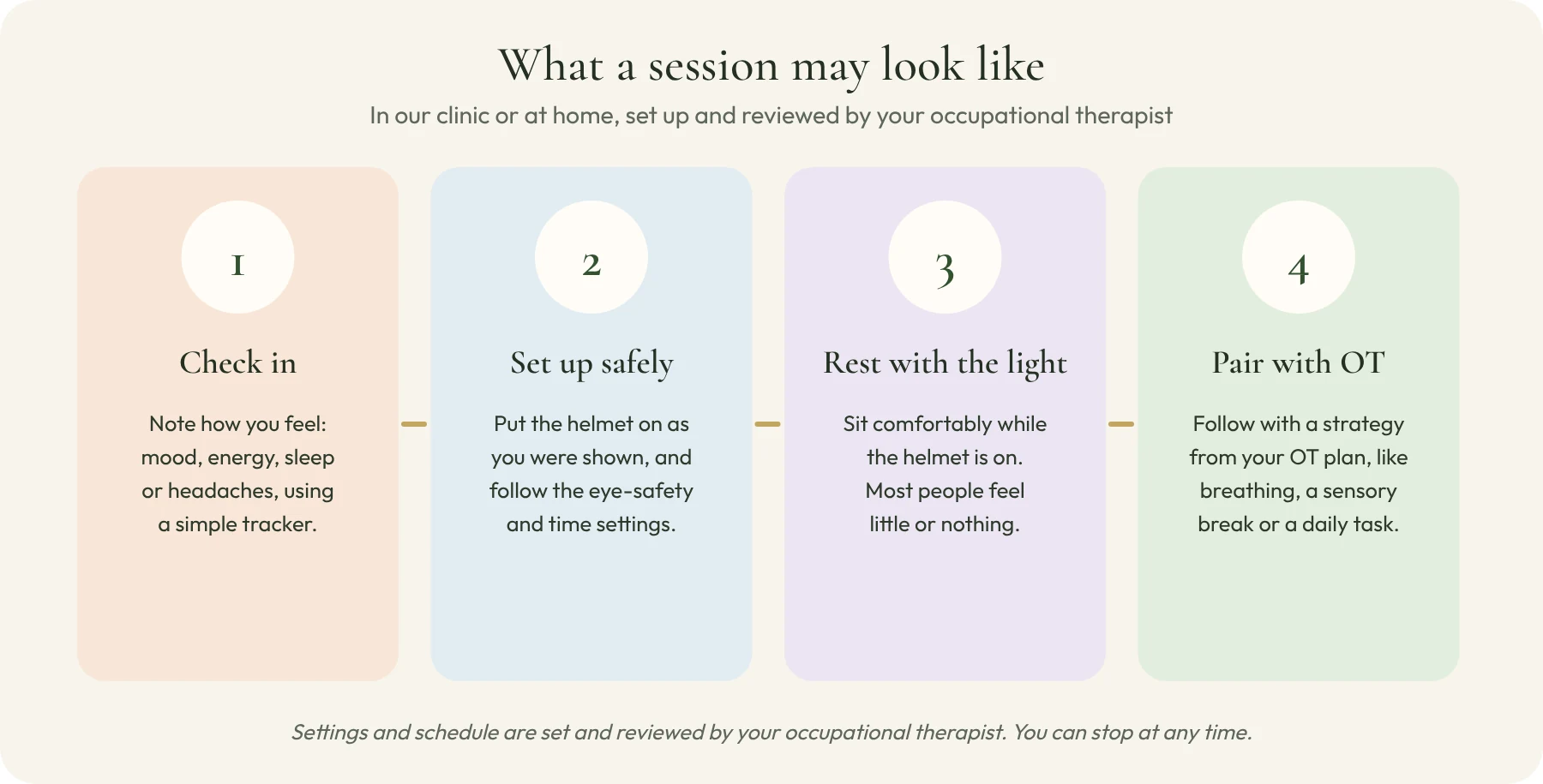
Seated sessions in clinic or at home, paired with strategies from your OT plan. A simple tracker notes mood, energy, sleep and any headaches.
We review your tracker together, adjust the plan, pause or stop, and keep your GP and other providers in the loop where you agree.
Sessions are simple. You sit comfortably with the helmet on, and most people feel little or nothing; some notice gentle warmth. There are no needles and nothing to get right. Sessions can happen in our Wembley clinic or at home. Your occupational therapist sets the settings and schedule with you, and adjusts them based on how you respond.
We may include PBM for children and teenagers from an age our occupational therapist assesses as suitable. It isn't offered to very young children. A parent or carer is involved in every step, and supervises home use.
Research into transcranial photobiomodulation for mental health is growing, but it is still early. Most studies are small, use different devices and doses, and some have no comparison group. Reviews describe PBM as a possible complementary option that needs larger, well-designed trials. This is general information about research, not a claim that PBM treats, cures or prevents any condition.
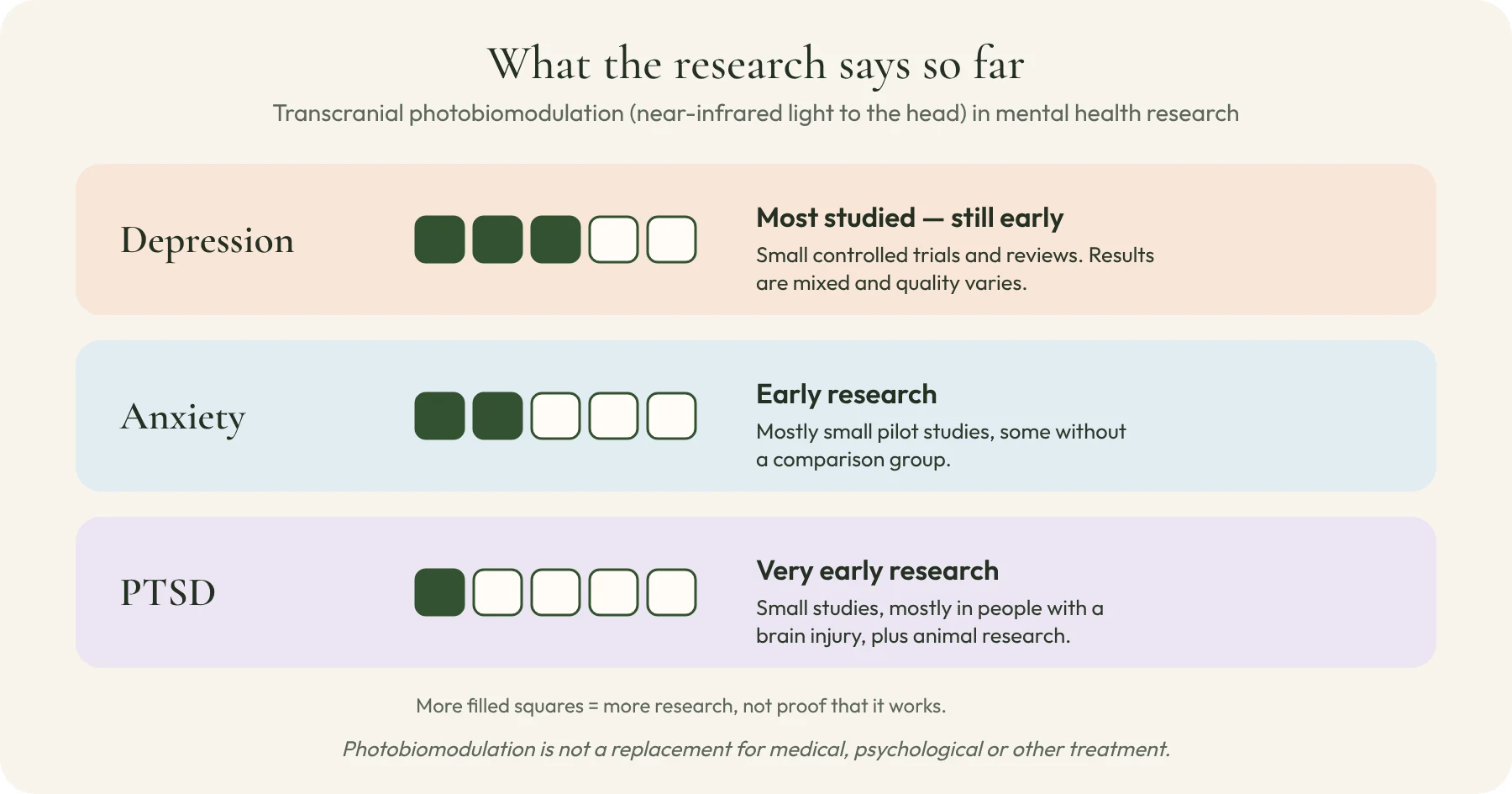
Small controlled trials and a 2024 review of 11 trials suggest PBM may reduce symptoms for some people, but the authors rated the certainty of the evidence as moderate to very low. An early ten-person pilot reported lower depression scores, but the later scores had no comparison group. A later small sham-controlled trial also reported lower scores in some adults. Another randomised study found a benefit only in people whose attention also responded to a computer-based task. Results are mixed: one 2025 trial of a low-power home headband found no difference from a sham device for mood, although sleep scores improved. Many of these studies used lasers or other devices, not the helmet used in clinic, and larger trials are still needed.
Evidence comes mainly from small pilot studies. One open-label study in adults with generalised anxiety, without a comparison group, reported lower anxiety and better sleep scores. Anxiety has also been measured in small depression pilots. Larger controlled trials are needed.
Human studies are few and small, and most include people who also have a brain injury. Some findings come from animal research only. Much of the wider "light therapy" research for PTSD looks at bright light to the eyes, which is a different approach.
Two small randomised studies in healthy young adults, using a 1064 nm laser, reported better attention and memory on lab tests than a placebo or sham condition. A 2019 review and meta-analysis of similar studies in young healthy adults also reported better cognitive test scores, but noted the studies varied a lot, were of modest quality, and differed widely from one another. A small placebo-controlled pilot in healthy adults over 45, using a 1068 nm LED helmet, reported better memory, motor function and processing speed than placebo. These findings are early, often come from lasers or other devices rather than the helmet used in clinic, and need confirming in larger trials.
Small open studies have explored thinking and memory after mild brain injury. In a randomised trial in moderate brain injury, light therapy was safe, but symptom scores did not differ from sham. Small studies in dementia, including one sham-controlled trial, and early studies in Parkinson's disease report encouraging changes but need confirming. Much of the stroke and Parkinson's research is in animals, which may not translate to people.
A small randomised, placebo-controlled trial in children and adolescents, using a 635 nm red laser (a different type of device from a near-infrared helmet), reported lower irritability scores. There is also a small open-label study in adults and a retrospective review of children's records, neither of which had a comparison group. Early research suggests photobiomodulation may help with some behaviours such as irritability, but the studies are small, used different devices, and need confirming in larger trials.
Across studies, photobiomodulation has generally been well tolerated. The most common side effects reported are mild and short-lived, such as headache, tiredness, irritability or trouble sleeping.
Studies used different devices, wavelengths and settings, so their results can't simply be compared or applied to any one device.
| Study | Who | Light | Design |
|---|---|---|---|
| Barrett & Gonzalez-Lima 2013 | Healthy young adults (40) | 1064 nm laser | Randomised, placebo-controlled; single session |
| Hwang 2016 | Healthy young adults (60) | 1064 nm laser (also compared with exercise) | Randomised, sham-controlled |
| Salehpour 2019 | Healthy adults (9 studies) | Various | Systematic review and meta-analysis; modest-quality studies |
| Dougal 2021 | Healthy adults over 45 (27) | 1068 nm LED helmet | Small placebo-controlled pilot |
| Schiffer 2009 | Adults with depression and anxiety (10) | Near-infrared to the forehead | Very small pilot; later mood scores had no comparison group |
| Cassano 2018 (ELATED-2) | Adults with depression | 823 nm LED | Small sham-controlled pilot |
| Disner 2016 | Adults with elevated depression symptoms (51) | Laser to the forehead, with a computer-based attention task | Randomised, sham-controlled |
| Guu 2025 | Adults with depression (48) | Low-power wearable headband | Sham-controlled; no mood difference, sleep improved |
| Maiello 2019 | Adults with generalised anxiety (15) | 830 nm LED headband | Open-label pilot |
| Naeser 2014 | Chronic mild brain injury (11) | 633/870 nm LED | Open-label pilot |
| Figueiro Longo 2020 | Moderate brain injury (68 randomised) | Near-infrared helmet | Randomised, sham-controlled; safe, no difference in symptom scores |
| Lee 2025 | Mild brain injury (17) | Transcranial PBM | Small sham-controlled crossover |
| Saltmarche 2017; Chao 2019 | Dementia (5; 8) | 810 nm LED | Case series; small pilot |
| Nizamutdinov 2021 | Mild–moderate dementia (60) | Low-power near-infrared device | Randomised, sham-controlled |
| Hamilton 2019; Liebert 2021 | Parkinson's disease (6; 12) | Red/near-infrared | Case observations; proof-of-concept with waitlist |
| Leisman 2018 | Children and adolescents with autism (40) | 635 nm laser | Randomised, placebo-controlled |
| Ceranoglu 2022; Pallanti 2022 | Autism: adults (10); children (21) | Near-infrared | Open-label pilot; retrospective review |
Low-level photobiomodulation has generally been well tolerated in research. Side effects, when they happen, are usually mild and pass quickly. A 2026 review of red light skin devices describes rare, dose-dependent skin effects such as redness and discomfort from warmth, and, very rarely, blistering (Spongberg et al., 2026). Before recommending PBM, our team checks your health history and talks with you about whether to involve your GP or specialist.
Never look directly into the light, and always follow the device's eye-safety instructions. Stop and let us know if you have headaches, skin irritation or anything else that worries you. PBM does not replace medication, psychological therapy or medical care. Please don't change any treatment without talking to your doctor.
Assessment, setup, training and reviews are part of your occupational therapy sessions, charged at our standard OT fee. See fees and funding for current fees and the ways you may be able to pay, including the NDIS (self-managed or plan-managed).
For home use, you can hire or buy a helmet through us. Hire and purchase prices are available on enquiry, so please contact us and we'll explain the options and costs before you decide.
For NDIS participants, a helmet may be requested as low-cost assistive technology. Whether it is funded depends on the NDIA and your plan, and we can't promise a funding decision.
It has been studied most for pain, wound healing and mouth sores after cancer treatment. Its use for brain and mental health is newer and still experimental. In our practice it is only ever an optional part of an occupational therapy plan.
They are closely related. "Red light therapy" is a general term. Photobiomodulation is the scientific name and includes near-infrared light, which most brain-focused research uses.
Research is still emerging. Some small studies are encouraging, others show no clear difference from a sham device, and larger trials are needed. We can't promise any result, and we'll review with you regularly whether it's worth continuing.
It has generally been well tolerated in research, with mild, short-lived side effects such as headache or tiredness. It isn't suitable for everyone, so we check your health history first. See the safety section above.
It may, as low-cost assistive technology, if the NDIA decides it meets their rules for your plan. We can assess whether it fits your goals and prepare the clinical information. We can't promise a funding decision.
Yes. In our practice, photobiomodulation is always paired with occupational therapy and reviewed by your therapist. It is never offered on its own.
Yes, for the support around it. The light sessions themselves happen in our clinic or at home with a helmet. Setup, training and reviews can be in person in Wembley or by telehealth, depending on what suits you and what is safe.
Yes. We offer helmets for hire and for purchase, always alongside occupational therapy. Prices are available on enquiry, so please contact us.
Yes. Sessions can be part of your appointments at our Wembley clinic, at home with a hired or purchased helmet, or a mix of both.
We may include it for children and teenagers from an age our occupational therapist assesses as suitable, but not for very young children. A parent or carer is always involved and supervises home use.
Neurofeedback reads the brain's activity and gives feedback through sound; nothing is sent into the brain. Photobiomodulation delivers low-level light to the head. Some people use one, both or neither. See neurofeedback.
Start with a 15-Minute Free Discovery Call. We'll listen, answer your questions honestly and help you decide whether photobiomodulation, occupational therapy or something else fits your goals. We can also talk you through hire and purchase options.
Photobiomodulation is offered only as part of an occupational therapy plan. It does not diagnose, treat, cure or prevent any medical or mental health condition, and individual experiences vary. It is not a substitute for care from your GP, psychiatrist, psychologist or other health professional. We do not promise any outcome or funding decision. If you need urgent support, call Lifeline on 13 11 14 or 000 in an emergency.