NDIS OCCUPATIONAL THERAPY · PERTH AND ONLINE
Occupational Therapy for People with Down Syndrome
Practical occupational therapy for children, young people and adults with Down syndrome, in Perth and by telehealth, and for the families and carers around them. We start with the person, and with the daily things that matter to them.
15-Minute Free Discovery Call: a short phone call, no obligation to book · Care led by Bita Farahani, Founder and Senior Occupational Therapist, with 21 years’ experience · Refer to Us · Contact Us

Who it’s for
Children, young people and adults with Down syndrome, and their families and carers.
Where
Home, school or work, the community, our Wembley base, or telehealth across Australia where suitable.
Our approach
Person-first and practical. We start with strengths, choices and goals, and we pace the work so it feels manageable.
What you receive
Shared functional goals, routines and strategies that fit real life, and written recommendations when needed.
Referrals
Self-referral welcome, plus families, GPs, schools, support coordinators and other professionals.
A PERSON-FIRST APPROACH
Starting with the person
Down syndrome is a genetic condition. People with Down syndrome have their own strengths, interests and support needs, and their own ways of taking part in daily life. Some people with Down syndrome also have an intellectual disability. What stays the same is that every person deserves support that respects their choices and builds on their strengths.
Occupational therapy starts with the person — and with what they and their family want to work towards — rather than with a list of deficits. We listen first. Goals are set together. Progress is measured against those goals, at a pace that feels right.
You do not need to have everything figured out before you get in touch. A 15-Minute Free Discovery Call is a short, no-obligation conversation to see whether occupational therapy may be a good fit.
Some people with Down syndrome also have an intellectual disability. Occupational therapy for people with intellectual disability is on our NDIS OT for intellectual disability page.
DOWN SYNDROME
Occupational therapy for people with Down syndrome
People with Down syndrome have their own strengths, interests and ways of taking part in daily life. Occupational therapy starts with the person — and with what they and their family want to work towards — rather than with a list of deficits.
Our occupational therapy may support people with Down syndrome with daily living skills, routines, communication, sensory needs and participation at home, at school, at work and in the community. Health, learning and support needs vary widely from person to person, and they can change with age. The plan is built around the individual in front of us, not around a standard programme.
We work with children, young people and adults. Goals are set together. Progress is measured against those goals, at a pace that feels right.
Across childhood, adolescence and adulthood
Children
Early years and school-age support may include play, daily routines, sensory comfort, communication in everyday tasks, and taking part at home and at school, alongside the family and the existing therapy team.
Teens
As more independence is expected, we may work on life skills, organisation, friendships and community participation, and on routines that can grow with the young person.
Adults
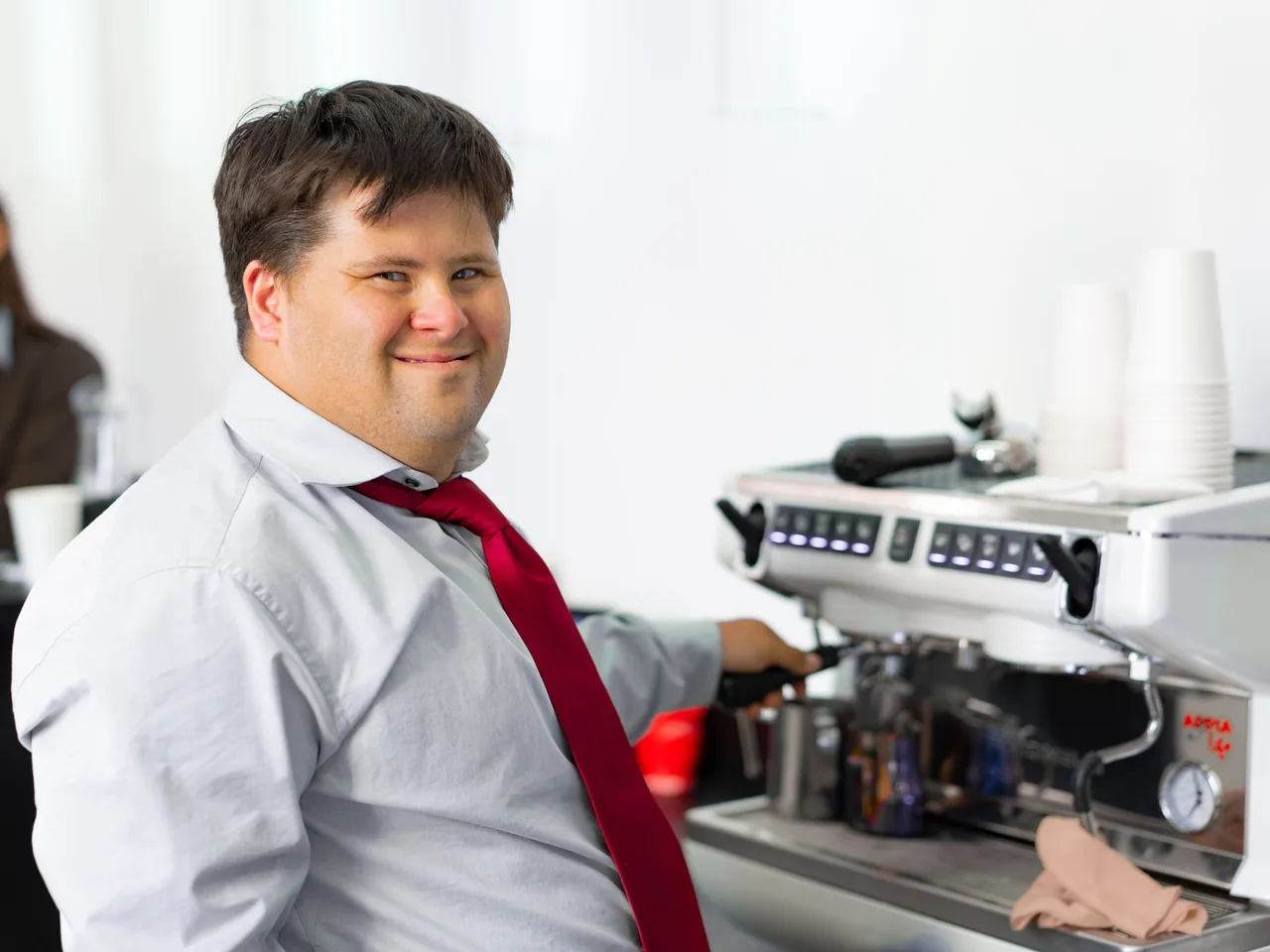
Adult goals may include independence at home, work or day activities, community access, and staying involved in the roles and relationships that matter. Families and support workers may be part of that plan where the person wants them to be.
HOW OCCUPATIONAL THERAPY MAY HELP
Practical support for everyday life
Occupational therapy looks at the daily things that make a life work: routines, skills, the environment, and the people around the person. Our work may support people with Down syndrome with practical, NDIS-aligned functional goals. We cannot promise a particular outcome; what we work on is agreed together and reviewed over time.
Daily routines
Morning, mealtime, after-school and bedtime routines may be broken into clear, repeatable steps that fit the person’s day and energy.
Independence
We may work, step by step, on self-care, household tasks and the skills a person wants to do with less help — at a pace that feels manageable.
Participation
Support may focus on taking part in family life, community activities, outings, groups, and the roles that matter to the person.
Communication support
We may use visual supports, simpler steps and consistent cues in daily routines, and we may work alongside a speech pathologist where that is already part of the person’s team.
Sensory needs
If noise, touch, movement or busy places make daily life harder, we may explore sensory strategies and environmental changes that support regulation and participation.
Life skills
Cooking, shopping, money skills, hobbies and leisure, and getting around the community at a suitable level, may be practised in real settings, not only in the clinic.
School and work
We may help with the practical side of school or work: arriving, organising tasks, sensory comfort, breaks, and working with teachers or employers where consent is given.
Families and carers
Where it is helpful, we may offer coaching and simple strategies for families, carers and support workers, so the person is supported consistently between sessions.
DAILY LIFE, ROUTINES AND SKILLS
The everyday things we may work on
The hardest parts of the day are often the ordinary ones: getting out the door, moving from one activity to another, staying with a task, or winding down at night. Occupational therapy may help by looking at the whole day, not only one skill in isolation.
That can include getting ready, meals, personal care, communication during routines, and taking part in family and community life. We use what already works, add structure where it helps, and practise in the places the person actually lives, learns and spends time, including by telehealth where that is suitable.
ACROSS THE LIFESPAN
Support that can grow with the person
People with Down syndrome may need different support at different stages of life. A child’s goals are not the same as a teenager’s or an adult’s. We review the plan as life changes — a new school, a job, a move, or a change in who is providing support at home.
We may also work with the people around the person, so strategies are consistent and respectful. The person remains at the centre of the work.
NDIS, FUNDING AND FAMILY SUPPORT
How occupational therapy may be funded
We work with NDIS participants first: self-managed, plan-managed and agency-managed, for occupational therapy. You do not need to have every funding detail confirmed before a 15-Minute Free Discovery Call. Eligibility and what a plan or package can be used for are decided by the funder. We cannot promise a rebate or a funding decision.
NDIS
Occupational therapy may be funded through the NDIS for eligible participants, where it is part of the person’s plan. The NDIS looks at how daily life is affected, and decisions are made by the NDIA. OT and the NDIS.
Private health insurance
Some private health extras policies may include occupational therapy; please check your cover with your insurer.
Medicare rebate
With a GP referral under a Chronic Condition Management Plan, a Medicare rebate may apply for eligible people; please check with your GP.
Private paid
You can also self-fund sessions. Current fees are on our Fees page.
WHERE NEUROPTIMAL® MAY FIT
A tool inside an occupational therapy plan
Where it fits, gentle NeurOptimal® brain training may be used as one tool inside an occupational therapy plan. Sessions are paced and can include a support person. NeurOptimal® does not diagnose, treat or cure, and it does not change a diagnosis.
It is not used on its own for people with Down syndrome, and it is not suitable for everyone. Whether it may have a place in a plan is something we talk through with you. You can read more on our Neurofeedback and intellectual disability page.
YOUR JOURNEY WITH US
From first call to your own plan
Care is led by Bita Farahani, Founder and Senior Occupational Therapist, with 21 years’ experience. This is what working with us usually looks like. We meet you where you are, and walk alongside you toward the goals you set together.
Get in touch
Call 0406 107 775 or use our Contact Us page. You do not need to know which service you need. Professionals can refer to us.
15-Minute Free Discovery Call
A short phone call about daily life, goals, where sessions could happen and how funding may work. No charge and no obligation. It is not an assessment or a therapy session.
Getting to know you
An occupational therapy assessment of daily life: conversations, observation and, where useful, standardised tools and input from family, school or support workers. It looks at everyday function and is not a diagnosis.
Goals together
We agree on a few functional goals that matter to the person, such as a calmer morning routine, more independence with a daily task, or taking part in a community activity.
Sessions and practice
Sessions at home, at school or work, in the community, in Wembley or by telehealth, with simple strategies to try between sessions and coaching for the people around the person, where that is helpful.
Review and next steps
We check progress against the agreed goals, adjust the plan, and provide reports or recommendations when needed. You decide how long to continue.
QUESTIONS
Your questions about occupational therapy
What does an occupational therapist do for people with Down syndrome?
An occupational therapist looks at everyday life — getting ready, meals, communication, school or work, and taking part at home and in the community. Together we may work on daily living skills, routines, communication, sensory needs and participation at home, at school, at work and in the community, in line with the person’s own goals. We do not promise a particular result, and we do not diagnose Down syndrome.
Do you also work with people with intellectual disability?
Yes. We work with children, young people and adults with intellectual disability. Occupational therapy for people with intellectual disability is on our NDIS OT for intellectual disability page. Some people with Down syndrome also have an intellectual disability; we can talk through which page, or which mix of support, may be the better starting point.
Do I need a diagnosis to see you?
No. You do not need a diagnosis to book a 15-Minute Free Discovery Call. Occupational therapists do not diagnose Down syndrome or intellectual disability. If you have questions about diagnosis, your GP is the first step. Families, support coordinators and other professionals can also make a referral.
Can the NDIS fund occupational therapy?
Occupational therapy may be funded through the NDIS for eligible participants, where it is part of the person’s plan. We work with self-managed, plan-managed and agency-managed participants for occupational therapy. Eligibility and what a plan can be used for are decided by the National Disability Insurance Agency. We cannot promise or guarantee any funding decision. Please see our Fees page for a general overview, and check with your plan manager or the NDIA.
Do you work with children, teens and adults?
Yes. We work with children, young people and adults with Down syndrome, and with the families and carers around them. Goals change across the lifespan, and the plan is built around the person in front of us.
Where do sessions happen? Do you offer telehealth?
In Perth we may see people at home, at school or work, in the community, or at our Wembley base. Telehealth is available across Australia where it is a suitable way to work toward the person’s goals. We talk through the options on the 15-Minute Free Discovery Call.
How are families and carers involved?
We start by listening to the person first, and to families and carers. Where it is helpful, we may offer coaching, routines and simple strategies that the people around the person can use between sessions. The person remains at the centre of the plan.
How does NeurOptimal® neurofeedback fit?
Where it fits, gentle NeurOptimal® brain training may be used as one tool inside an occupational therapy plan. It does not diagnose, treat or cure, and it does not change a diagnosis. You can read more on our Neurofeedback and intellectual disability page. We cannot promise any particular result.
What happens in a 15-Minute Free Discovery Call?
It is a short phone call about daily life, goals, where sessions could happen and how funding may work. There is no charge and no obligation to book. It is not an assessment or a therapy session.
READY WHEN YOU ARE
Start with a 15-Minute Free Discovery Call
A short phone call about daily life, goals and what may help. No charge and no obligation to book. Call 0406 107 775, or use our Contact Us page.
Occupational therapy does not replace medical, psychological or other specialist care. We do not diagnose intellectual disability or Down syndrome, and we do not promise any particular outcome or funding decision. Results vary from person to person. NeurOptimal® neurofeedback is a general wellness brain-training system. It does not diagnose, treat, prevent or cure any medical or psychological condition. It is not a substitute for advice or care from your GP or another qualified health professional. If you need urgent support, call Lifeline on 13 11 14 or 000 in an emergency. NeurOptimal® and Dynamical Neurofeedback® are registered trademarks of Zengar Institute Inc. Funding information is general; please confirm current rules with the funder. Session fees are on our Fees page.
Mental Health OT Australia Pty Ltd · ACN 700 512 161